Friday, January 1, 2016

Paxsi

Cat #------Name----Certainty---Long---Lat-----Diameter---Radar Swath---------------------------------------------------------   
None     Paxsi-----1  --     341.2W 5N--  120 km--  T108
Above: Discovery images from VIMS.

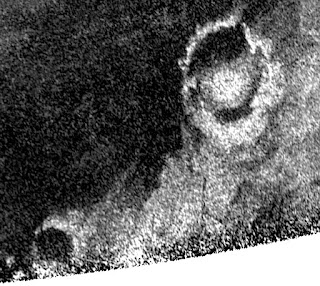
Below: T108 Radar image showing bright-rimmed, crater with dark floor. Crater is elongated north to south, and central peak complex is significantly offset to south. Center of peak is circular and bright, surrounded by apron of fainter material with radial lineations - perhaps due to downslope movement.

At bottom left is another bright-rimmed, dark-floored feature that may be another impact crater.


Publications:
Buratti, B.J. and 9 others (2012) A newly discovered impact crater in Titan's Senkyo: Cassini VIMS observations and comparison with other impact features. Planetary and Space Science 60, 18-25.

Beag

Cat #------Name----Certainty---Long---Lat-----Diameter---Radar Swath---------------------------------------------------------   
None      Beag-----  2  -- 169.6W 34.7S--27 km--     T98
Apparently complete elevated rim with possible faint radial streaks to west and east that may be ejecta. Interior is nearly filled with broad, circular bright zone, separated from rim in many places by a dark moat. Very unusual interior.

Afekan

Cat #------Name----Certainty---Long---...Lat-----Diameter---Radar Swath--------------------------------------------------------
None.....Afekan-----1.........200.3W 25.8N...15 km........T43

Completely rimmed crater surrounded by radially lineated ejecta. Small but bright central peaks and mostly dark floor, with streaks and broader, more amorphous bright deposits.

This is NL2 of Neish and Lorenz (2012).

Hano

-Cat #------Name----Certainty---Long---Lat-----Diameter---Radar Swath----------------------------------------------------------
 28-----      Hano-----   2            344.7W 40.2N-N110 km----------T16---
T84 + T104 Radar Mosaic
Mountainous, bright, apparently jagged rim. Dark floor. with broad arc of bright/rough terrain on south side. Strange chain of about six craters?? across floor - is this an artifact or real? If real, only a breakup of an incoming projectile is a known explanation. 

Forseti

Cat #------Name----Certainty---Long---Lat-----Diameter---Radar Swath--------------------------------------------------------
5---          Forseti-- --  1         10.5W   5.7N-- -139 km----------T23, T84 HiSar and T113 Seg 7-

Soi

-Cat #------Name----Certainty---Long---Lat-----Diameter---Radar Swath----------------------------------------------------------
 4----           Soi--       -   1        139.6W 22.7N---- -75 km------....T16--
Bright jagged-looking rim, with dark floor, and apparent ejecta. Said to be extremely degraded, but the rim is complete and a hint of a central peaks exists. Main degradations appears to be infilling of the floor by materials similar in radar reflectivity to exterior surroundings.

Sinlap

-Cat #------Name----Certainty---Long---Lat-----Diameter---Radar Swath------------------------------------------------------
 2-----        Sinlap---      1          16.1W  N11.3-----79 km-------- T03---

First crater discovered on Titan. Similar in appearance to craters on Earth, Moon and Mars that have had aeolian deposition of sediments reduce original depth. Broad flat floor with bright streaks and northern third dusted with brightness. Strangely, VIMS indicated bright spot in center but higher resolution radar shows no central peak.
Close-in dark halo in radar, with broader brighter ejecta beyond. The 2008 Le Mouelic paper finds evidence for "the presence of an area enriched in water ice around the main ejecta blanket.   
    Image from Le Mouelic et al (20018)

Publications: 
2008: Le, Mouelic, S.; Paillou, P.; Janssen, M. A.; Barnes, J. W.; Rodriguez, S.; Sotin, C.; Brown, R. H.; Baines, K. H.; Buratti, B. J.; Clark, R. N.; Crapeau, M.; Encrenaz, P. J.; Jaumann, R.; Geudtner, D.; Paganelli, F.; Soderblom, L.; Tobie, G.; Wall, S. Mapping and interpretation of Sinlap crater on Titan using Cassini VIMS and RADAR data. Journal of Geophysical Research E: Planets, 113 (abstract).